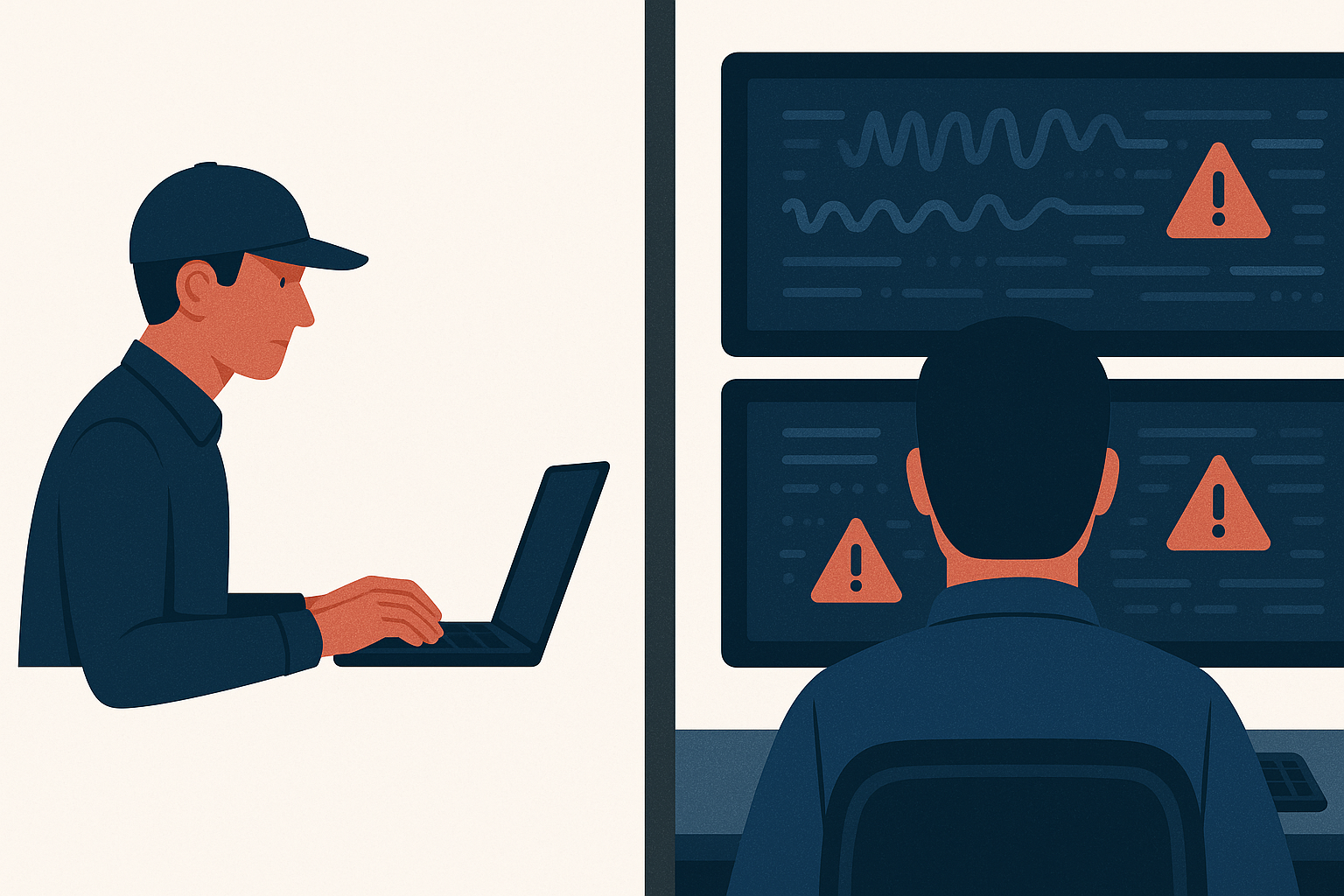


Regulators around the world are raising cybersecurity requirements for critical systems, and penetration testing is becoming mandatory in many industries. The problem is that classic manual pentesting is expensive and takes about a month, which isn't fast enough to keep up with today's threats. That's why autonomous pentesting and AI pentesting are gaining popularity. In this article, we'll break down what they are, whether you can trust them, and what to look for when choosing one.
What Is Autonomous Pentesting
Autonomous pentesting is penetration testing carried out without a human specialist. Instead of a human, the attacks are ran by AI: it scans the infrastructure, picks and launches attack scenarios, analyzes the results, and generates reports. That's a fairly broad explanation, and in practice there are many nuances in how autonomous pentesting actually works.
Alongside autonomous pentesting, the term AI pentest (AI pentesting) is also commonly used. Frankly speaking, both of them have no single agreed definition, although the terms are getting more and more popular thanks to marketing. In some products, "AI" just summarizes results from a classic scanner. In others, an AI agents make real-time actions like a real human pentester. Some companies define AI Pentest specifically as pentesting solution built on an agentic architecture. But since the terminology hasn't settled yet, we think it's more useful to focus not on terms, but on what products actually exist on the market and what they can do — and judge their effectiveness from there.
Broadly speaking, the market today proposes two generations of solutions of automated pentesting. The first is essentially a classic vulnerability scanner with an AI wrapper: it works from fixed rules, matches software versions against CVE databases and produces a list of potential risks, but doesn't actually try to exploit them.
The second generation is agentic systems, where AI builds hypotheses, generates and launches real attacks, analyzes the target's response, adjusts its approach, and chains small findings together into a full exploitation path on its own.
How to Choose an Autonomous Pentest in 2026
Architecture
Most services on the market in 2026 are the first-generation autonomous pentests we mentioned earlier that run on prompts. Their architecture usually combines a standard open-source vulnerability scanner with a large language model (LLM) connected through an API. The "automation" here mostly comes down to processing scan results: the tool's raw technical output is fed to the model with a prompt asking it to turn that data into a human-readable report. This approach has three major problems:
- An LLM without clear engineering constraints starts inventing vulnerabilities that don't exist, or misses critical ones.
- An AI wrapper doesn't think like a hacker. It can't connect three small issues into one critical compromise chain (a kill chain).
- Any AI is "lazy" by default and may just simulate work to save on tokens. Prompting alone can't fix this limitation.
The second, more modern approach is built on an agentic architecture. Here, instead of one general-purpose model, the system is run by a network of specialized AI agents, each handling one specific function. They operate within clear protocols (such as OWASP or PTES) and don't skip important steps to save on tokens.
Every step is logged, validated, and verified in practice through safe exploitation of the vulnerability, which gives each finding a Proof of Concept. This approach can be genuinely effective, but the methodology behind how the agents operate is what really matters next.
Methodology
A genuinely effective alternative to manual pentesting is an AI pentest built on a multi-agent architecture and a rigorous methodology. That methodology can vary from one provider to another.
Here's how an automated pentest can run in practice, using A42's AI Pentest as an example — a solution built on a multi-agent architecture. Its methodology is based on more than 100 proprietary attack scenarios drawn from the real playbooks of leading ethical hackers in GovTech and Defense Tech. An orchestrator AI agent makes sure this methodology is followed step by step. Under the hood, more than 130 specialized AI agents work in parallel, fully replicating a pentester's actions according to the methodology.
The testing process has four sequential stages. First is passive reconnaissance: gathering data from open sources — subdomain analysis, WHOIS, DNS, metadata, and frameworks. This builds a map of the digital perimeter without alerting any defenses.
Next is active reconnaissance: port scanning (Nmap, Masscan, Nessus) and banner grabbing to pin down which services are running, their versions, and whether they're exposed to attack. In the third stage, AI agents run automated scans for baseline vulnerabilities, each agent drawing on dozens of classic and advanced tools.
The fourth stage is deep testing of the subdomains that matter most to the business. Agents carry out the actions of an experienced hacker: breaking authentication mechanisms (JWT, OAuth, Basic Auth), testing privilege escalation, running injections (SQL, NoSQL, LDAP, OS), XSS, RCE, and XXE attacks. They also separately check for request desynchronization (HTTP request smuggling, CRLF injection), business logic bypasses, and file upload attacks.
An experienced pentester then reviews every finding from the agents and prepares the professional report.
What to Look for When Choosing an AI Pentest
If you're looking for a solution for your own company, or you're a provider that wants to cover security for your clients, evaluate autonomous platforms against these criteria:
1. Architecture and methodology
As we mentioned, an AI pentest needs to be built on a multi-agent architecture with a clear methodology. Just as every experienced ethical hacker or pentest provider has their own methodology, and it doesn't necessarily match a competitor's, autonomous pentests can differ too.
2. Proof of Concept
What you get shouldn't just be a CVSS score — it should be a Proof of Concept (PoC): clear evidence or a scenario confirming that the bug is real and genuinely critical to the system. That means every potential vulnerability found has to be automatically verified in practice. It's important, though, that this verification happens through safe exploitation, so it doesn't damage the infrastructure. That should be built into the pentest's architecture from the start, and how exactly verification happens should be agreed with the client in advance.
3. Compliance
Security rarely exists in a vacuum, most often, it is needed to run a business successfully, sign contracts and operate on different markets. This is why, the reports need to be structured so that your partners' technical leadership, compliance officers and external auditors can accept them without a lot of follow-up questions. Make sure the service's methodology automatically covers:
- thorough technical checklist based on OWASP Top 10 / WSTG;
- international standards like ISO 27001 and SOC 2;
- industry regulations, such as Europe's DORA and NIS2 for fintech and critical infrastructure.
Final Thoughts
In 2026, as release cycles speed up and attacks become more automated, defense needs to stay ahead of the curve. Manual pentesting still has its place as an expert "second opinion," where budget or specific constraints call for it. But only automation can meet the need for continuous, in-depth infrastructure monitoring. Moving to autonomous pentesting is the only way to keep pace with development without putting data security at risk, while still meeting international compliance requirements.
Don't wait for real hackers to test your infrastructure. Try AI Pentest by A42.