

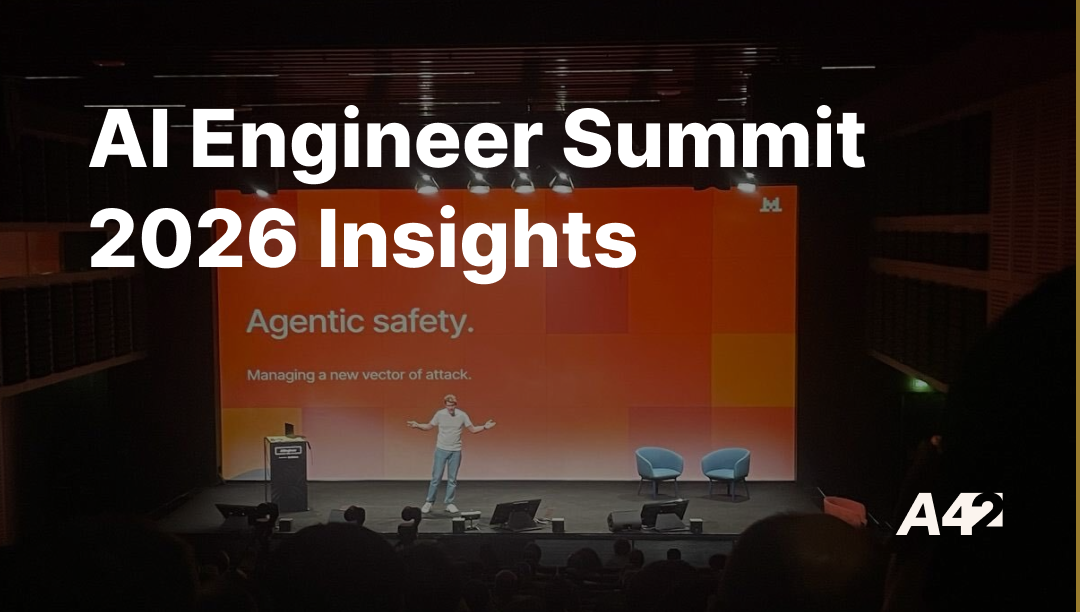
In late September, A42's AI Engineer Mykhailo had attended AI Engineer Summit in Paris, organized by Mistral AI, a French developer of large language models. Here are the key insights he brought back from Paris.
Two days at Station F, the world's largest startup campus, about a thousand attendees, including founders, engineers, and AI leaders. Speakers included teams from Mistral, NVIDIA, Google DeepMind, Hugging Face, ElevenLabs, and other companies.
What sets the AI Engineer Summit apart is that the people here are genuinely passionate about their work. People go there for the connections, not just the presentations. Incredible startups, energy-filled teams, a wealth of ideas, and full openness to collaboration and partnership. They are eager to find new solutions and experiment.
This year's agenda covered agentic development, coding agents, model evaluation and monitoring, and AI applications in regulated industries. But all these topics shared a common focus. The overwhelming majority of speakers and attendees spoke about agent safety, or Agentic Safety.
Mistral introduced Mistral Vibe. The tool allows for more detailed restriction of the set of commands an agent can execute and significantly simplifies testing new agents. Several startups showed their own solutions in the same domain. The industry is learning to control what an agent does inside the system.
This is the right direction. But it covers only half of the problem. An agent can be perfectly restricted and tested. However, it operates within an infrastructure that is attacked from the outside. Cyberattacks and security breaches are growing at an unprecedented rate every year, and for them, an agent with access to systems and data becomes yet another target.
Therefore, when we talk about the safe deployment of agents and their use in enterprise environments, asking what an agent is allowed to do is not enough. We must also ask another question: what happens if the system it operates in is attacked?
Internal agent safety and protection against external threats must evolve together. Otherwise, we are building a solid door on a house without walls.